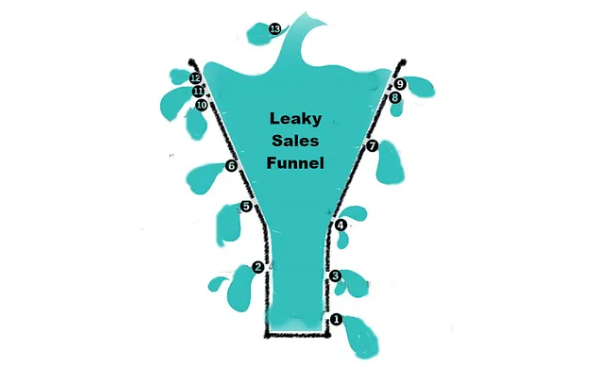
If your funnel is dripping cash, it’s not because the algorithm “doesn’t like you” or your audience has the attention span of a goldfish. It’s because your message is fighting itself.
Great funnels don’t “persuade” prospects so much as they reduce resistance at every click. Do that, and the sale feels inevitable. Miss a step, and you’re paying to pour traffic into a sieve.
Here’s a simple, ruthless, five-step hierarchy to plug the holes and get the money flowing your way.
Step 1: Pin down the one money idea (and the villain)
Before you write a word, decide: What’s the single, wallet-out reason to choose you—right now? Not three reasons. One.
Mass desire: What outcome is already burning in their gut? (More demos, better margins, younger-looking skin, fewer service callbacks.)
Primary mechanism: What do you do differently that makes the outcome believable?
Named villain: What’s the old way or the common mistake that’s been robbing them blind?
Quick exercise (do it):
“We help [avatar] get [#1 outcome] by [mechanism]—unlike [villain/old way].”
Examples:
“We help B2B teams double qualified demos with ‘intent-lift’ landing pages—unlike generic page templates.”
“We help local electricians book 30% more calls using ‘trust-triggered’ Google profiles—not coupon spam.”
Get that right, and every line you write has a spine.
Step 2: Nail the wallet-out headline (Outcome + Mechanism + Timeframe + Safety)
Your headline is not a welcome mat. It’s a money claim your prospect can’t unsee—anchored in a mechanism they can picture and a safety net that reduces risk.
Formula:
Outcome + Mechanism + Timeframe + Risk Reversal
Examples:
“Double your qualified demos in 21 days with Intent-Lift pages—try it risk-free for 30 days.”
“Book 42% more service calls this quarter using our Trust-Triggered Local Bundle—pay only after your first 10 new customers.”
Subheads & leads should extend, not repeat, the claim:
Name the pain: “Most funnels choke because the value is muffled.”
Agitate the cost: “Every day you wait, your CAC creeps and ROAS wheezes.”
Reintroduce your mechanism: “Here’s how Intent-Lift unblocks demand in under three weeks.”
If your headline can’t pass the “stranger gets it in five seconds” test, you’re funding confusion.
Step 3: Prove it until they feel it (stack hard + soft proof)
Prospects don’t buy what might work. They buy what already works—for people like them.
Build a proof ladder:
Hard proof (priority)
Specific numbers (“36% lift in form completes in 18 days”)
Before/after screenshots (analytics, heatmaps, ad dashboards)
Third-party verification (G2, BBB, Google ratings, press mentions)
Named clients and niches (logos are great; short case vignettes are better)
Soft proof (support)
Fast GIF demos (scroll or tap; show the mechanism in motion)
Micro-case stories (3 sentences: situation → action → result)
Credibility markers (years in market, certifications, method name)
Credibility compounding tip:
Put your strongest proof immediately after the headline and again right before the offer. Proof is not seasoning—it’s the meat.
Step 4: Make saying “yes” safer than “no” (offer design, not discounting)
People don’t resist value. They resist risk and effort. Your offer should make acceptance the low-risk, low-effort, high-upside path.
Offer stack checklist
Core deliverable: What exactly do they get? Name it. Box it. Scope it.
Fast-win component: What do they see in the first 48–72 hours that proves traction?
Bonuses that remove work: Templates, swipe files, setup calls, implementation checklists.
Guarantee that matches the fear: Time-bound pilot, milestone-based fee, “keep the assets” safety.
Pricing frame: Anchor against their current pain (lost sales, high CAC), not your cost to deliver.
Scarcity that respects the buyer: Capacity limits, application windows, cohort start dates.
Example (service):
“Launch the Intent-Lift Quickstart: custom landing page, 3 conversion-safe variants, analytics wiring, and a 21-day optimization sprint. If we don’t lift qualified demos by at least 25% in 30 days, you keep the assets and pay nothing further.”
That’s not a cute guarantee. That’s an anti-fear device.
Step 5: Grease the slide (remove friction like a fanatic)
Your page should read like a well-oiled conversation, not a committee memo. Every element either accelerates momentum or steals it.
Friction killers
Visual hierarchy: Big promise → proof → mechanism snapshot → offer → CTA. No orphans.
Cognitive clarity: Short sentences. Concrete nouns. Active verbs. Kill buzzwords.
Micro-CTAs for skimmers: “See a live demo,” “Show me the 21-day plan,” “Compare results.”
FAQ that pre-handles objections: Time, price, contract length, integration, team workload.
Field minimization: Ask only for what you need to deliver the next win.
Mobile first: Thumb-reachable CTAs, legible type, single-column flow.
Load speed: A 3-second delay is a tax on trust. Compress assets. Defer scripts.
Grease test:
If a motivated buyer can’t convert in one uninterrupted minute on their phone, you still have leaks.
Contact me if you need help plugging your funnel!